Your First Visit to a New Court: Read the Layout First
A first visit to a new court is easier when you read entrances, playing areas and viewing positions before choosing where to settle.
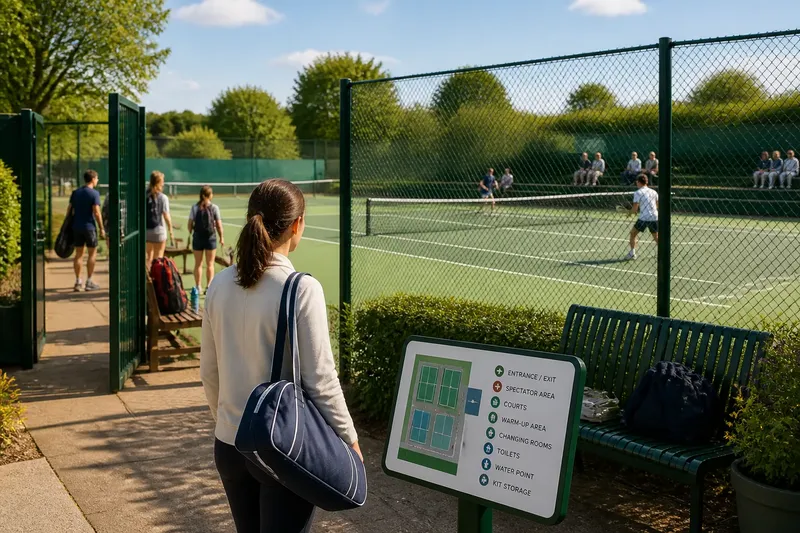
Where should you stand when you arrive at a new court? On a first visit to a new court, pause before choosing a seat or crossing the playing area: entrances, boundaries, viewing positions and shared routes tell you how the place is meant to work. A brief circuit can prevent the small awkwardness of discovering that your chosen spot is where everyone carries kit through.
This is not a safety inspection or a hunt for hidden rules. It is a way to understand the court as a place shared by players, spectators, staff and people waiting for their turn. Think of the layout like a kitchen worktop: the useful space is not simply the largest open patch, but the route between the things people need.
What should you notice before settling in?
Begin at the entrance and look for the ordinary signs of movement. A gate may open directly onto a run-off area; a side door may lead to changing rooms or another court. Notice where people arrive, where they leave bags, and whether anyone is already waiting to enter the playing space.
Then identify the actual playing area. Painted lines can overlap when a court is marked for several sports, so look for nets, posts, removable equipment and the activity taking place now. The main court is not always the only space in use: a warm-up area or adjacent court may have its own traffic and boundaries.
Next, find the viewing positions. These may be benches, a low stand, marked spectator space or simply an area beyond a fence. Look for sightlines as well as available seats. A place can be empty because a post, wall or equipment trolley blocks the view, not because it is an invitation to occupy it.
- Entrances: identify the usual route in and out, including any gate that opens onto the court.
- Playing boundaries: distinguish active lines from spare markings and notice where play can run beyond them.
- Viewing areas: look for seats or standing space that leave players’ routes clear.
- Shared spaces: locate benches, kit storage, water points and the places where people wait.
- People already using the venue: watch where they walk and pause before following their example.
How can you read the routes without getting in the way?
Walk around the outside edge where possible, rather than cutting across the court. Keep an eye on doorways, gates and narrow passages: these can serve as both entrances and routes between playing areas. If a match or practice is under way, let the activity continue and choose a position outside its playing and run-off space.
Watch a few ordinary transitions. Someone collecting a ball, changing ends or leaving after a game can reveal the intended route more clearly than a sign. Notice whether people wait beside a gate, along a wall or near a bench. These habits are clues, not permission to copy every choice; an established player may know an arrangement that is not obvious to a visitor.
At a staffed venue, ask a short, specific question if the layout remains unclear: “Is this the spectator area?” is more useful than a vague request to explain the whole building. At an unstaffed court, wait for a natural pause before entering, and avoid moving nets, cones or bags to make a route that suits you.
When should you choose a viewing position?
Choose only after you can see how the game and the foot traffic relate. A good position lets you watch without standing in a player’s approach, blocking a doorway or forcing others to squeeze past. If seating is available, leave room for people who need to pass and avoid spreading coats or bags across neighbouring places.
At an outdoor court, account for the way light, wind and nearby paths affect where people gather. A shaded bench may also be beside the entrance; a quiet corner may sit behind a player’s service line. Indoors, listen for calls and watch for balls travelling beyond the marked area. Neither setting has a universally best seat; the useful choice is the one that gives a clear view while leaving the shared routes usable.
If you are there to play rather than watch, find out where players wait and where they can put their belongings without narrowing a passage. Keep kit together and out of the playing area. A bag placed neatly beside a wall can still obstruct an exit or another court’s access, so check the route from the entrance to the activity space.
How can you make a first-visit plan for the morning?
Use the arrival itself as a short sequence rather than choosing a position on impulse. The exact order can flex around a busy venue, but each pause answers a different question.
- At arrival: stop just inside the entrance and identify where people enter, leave and wait. Do not move on until you can see whether the doorway opens onto active space.
- On the first circuit: follow the outer edge and locate the playing boundaries, adjacent courts and any areas used for warm-ups. Keep clear of play while you look.
- During a pause in activity: observe how players and spectators move between the court, benches and shared facilities. Note which routes stay open.
- Before settling: choose a viewing place or waiting spot that has a clear sightline and does not occupy a passage, boundary area or players’ approach.
- When leaving or changing courts: retrace the route you observed, and check that your belongings have not spread into shared space.
Say you arrive at a community tennis court while one game is ending and another group is waiting by the gate. You notice a bench beside the entrance, but also see players carrying racquets through that narrow gap. You walk the perimeter, find a viewing area beyond the fence, and settle there; the observable result is a clear view without turning the entrance into a bottleneck.
What questions come up on a first visit?
Can I cross the court if no one is playing?
Wait until you can tell whether the court is reserved, being prepared or used for warm-up. If the entry arrangement is unclear, ask staff or wait for someone familiar with the venue rather than treating an empty surface as an open route.
Where should I leave my bag?
Use a designated storage area if one is provided; otherwise keep the bag compact and away from entrances, walkways and court boundaries. A place beside a wall is not automatically clear if it blocks access to equipment or another playing space.
What if court markings overlap?
Use the equipment in place and the activity under way to work out which layout is active. If those clues conflict, check with the organiser before stepping onto the playing area or moving a net.
Is it all right to watch from the side?
Only if that side is outside the playing and run-off area and does not obstruct a shared route. Look for a designated viewing space or follow the venue’s posted directions.
What should you do when the layout is still unclear?
Pause at the edge rather than guessing. A court can host different activities at different times, and painted lines alone may not show which boundary matters now. Look for signs, posted schedules or a staff member; follow the venue’s instructions and any rules set by the organiser. Where an arrangement depends on the venue’s directions or equipment instructions, check those rather than improvising.
Keep your questions practical: where to wait, which entrance to use, and where spectators may stand. These details help you participate without asking someone to give a full tour while they are preparing to play. If no one is available and the boundary remains uncertain, stay outside the active area until the next clear opportunity.
On a first visit to a new court, reading the layout is less about memorising every line than understanding how people and play move through the space. Take the outer route, find the open viewing position and keep shared paths clear. Once those pieces make sense, choosing where to settle becomes a small decision rather than a tactical event.