Before the Synthetic Ball: A Brief History of Football Materials
Football materials history traces how leather, rubber and synthetic layers changed the ball’s shape, weather response and demands on its construction.
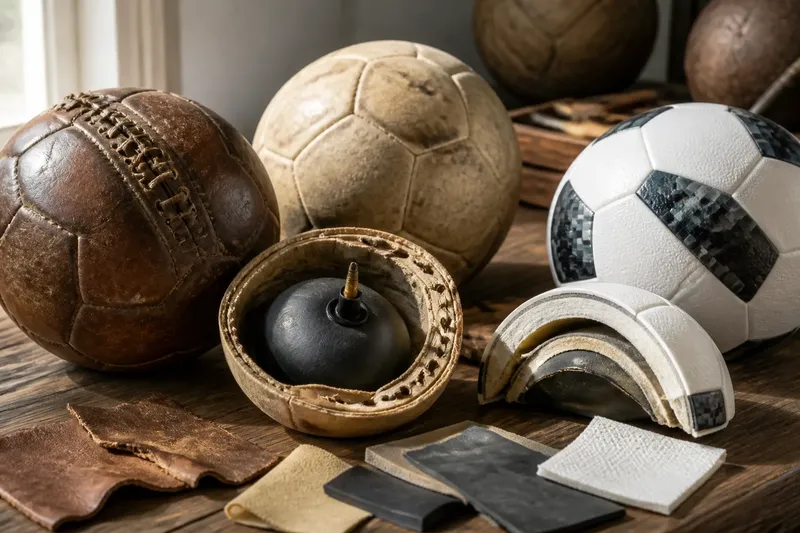
Football materials history begins with a problem players could feel: a ball made from animal parts could change under rain, while its seams and inner bladder had to keep it round enough to play. To understand how the synthetic ball arrived, follow the construction in order—from the outer casing towards the centre—and note what each material was asked to do.
What made early footballs from animal materials?
Before a standard ball became familiar, people played with objects made from whatever could be shaped and tied together. In different places, these included inflated animal bladders, wrapped skins and other available materials. Their forms varied, and so did their usefulness: an object that could be kicked was not necessarily consistent from one game to another.
As association football took shape, the leather-covered ball became the recognisable construction. Panels of leather were cut and stitched around an inflatable bladder. The bladder supplied the rebound; the leather casing protected it and held the ball’s form. In effect, the design separated two jobs that earlier improvised balls had handled less predictably.
Leather was workable and relatively tough, but it absorbed water. A wet casing could become heavier and less pliable, and the ball’s behaviour could change during play. The exposed stitching also mattered: it helped join the panels, but created raised seams and a vulnerable point where the casing could open. The ball was a piece of sporting equipment and, in damp weather, a small argument with gravity.
How did the bladder change the ball?
The bladder was the part that made inflation possible, but early versions were not as dependable as later rubber constructions. Animal bladders could vary in shape and resilience, and they needed a means of inflation. The casing’s design therefore depended on an inner component that was difficult to make uniform.
Rubber changed that relationship. A rubber bladder could hold air more consistently and return towards its shape after being compressed. That did not make every ball identical, but it gave makers a more reliable centre around which to build the casing. The distinction is like a coat wrapped around a firm cushion: changing the cushion affects the whole object, even if the outer fabric stays much the same.
Inflation also required an opening in the casing. Traditional balls used a lace closure, which allowed access to the bladder but left a raised seam. This was a practical compromise, not merely decoration. The closure had to secure the casing while remaining workable for inflation and repair, and it became one of the most visible features of older footballs.
Why did panel design and stitching matter?
Once the bladder could be made more consistent, attention could turn to how the outer casing controlled shape and protected the centre. Leather panels were stitched together, with their number and arrangement varying by maker and period. The familiar pattern of panels was not the only possible design; it was one way to balance roundness, durability and a construction that could be assembled from cut pieces.
Stitching carried a structural burden. It had to keep adjoining panels together when the ball was kicked, while the casing resisted stretching and scuffing. A seam that protruded could affect contact, and a seam that failed could expose the bladder. Panel layout, leather quality and the placement of the closure therefore worked as a system rather than as independent styling choices.
Say a club replacing a worn ball in an invented situation finds that the leather casing is cracked around the lace opening, while the bladder still holds air. The observable issue is not simply “old leather”: the closure and stitching have allowed wear to concentrate at a working joint. That small inspection illustrates why construction details, rather than the material name alone, shaped a ball’s service in play.
What changed when synthetic materials appeared?
Synthetic materials offered makers a way to reduce the casing’s dependence on water-sensitive leather and to control surface properties more deliberately. Rather than one simple replacement, synthetic construction developed through layered surfaces and backing materials. These could be formed to resist moisture, protect the inner structure and provide a consistent outer finish.
That shift changed the design question. With leather, makers had to work with a natural material whose properties varied and could alter when wet. Synthetic surfaces made it possible to specify a more repeatable texture and structure, while the arrangement of panels and the quality of their joins remained important. The ball still needed to retain air and shape; the new materials changed how those demands could be met.
Construction also moved beyond the idea that a casing must be a set of stitched leather pieces. Some designs used bonded or moulded panels, reducing reliance on exposed seams. The aim was not simply to make the ball look newer. A smoother exterior and different joining methods changed how the surface met a player’s foot and how the casing resisted water and wear.
Which questions help trace football materials history?
Why were leather balls troublesome in rain?
Leather absorbed water, so a wet casing could become heavier and behave differently from a dry one. This made weather a material issue as well as a playing condition.
Did rubber replace the leather casing?
No. Rubber chiefly improved the inner bladder, while leather remained a common outer covering for many traditional balls. The two materials served different parts of the construction.
Why did older balls have laces?
The lace closure gave access to the bladder for inflation and helped close the casing after assembly. It also left a raised seam, showing how a maintenance feature could affect the ball’s surface.
Did synthetic construction remove the need for panels?
No. Synthetic materials changed the available surfaces and joining methods, but the ball still needed a structure that held its shape. Panel design remained one way to organise that structure.
What should you notice when comparing old and newer construction?
Start with the layers: identify the outer casing, the method used to join its sections and the material that holds air. Then look at the seam or closure. These features reveal more about the ball’s design history than a label such as “leather” or “synthetic” on its own.
Next, consider what the material had to withstand. Leather’s vulnerability to water helped prompt interest in alternatives; improved bladders made inflation and shape more dependable; synthetic surfaces gave makers new ways to control texture and joining. Each change answered a construction problem, while creating different choices for the next generation of designers.
Football materials history is therefore best read as a sequence of linked adjustments, not a clean swap from one material to another. When you see an older laced ball beside a modern synthetic one, look past the surface: the revealing story sits in the bladder, the joins and the way the casing keeps its shape.